By Katy Barden
There are obvious parallels between sport and technology but the requirement – necessity, even – to move with the times and embrace change is perhaps the most notable.
Stephen Wallace, vice president of UK Athletics (UKA) and technical Official and head coach at Cumbernauld AAC, operates across both sectors in a professional and volunteer capacity.
In doing so, the IT specialist has a unique insight into athletics development and innovation (or lack of) across the Home Nations.
His four-year term at UKA commenced in December 2024 and he quickly identified similarities to his day job at Oracle in terms of information management: ‘One of our key learnings over the past number of years is that when we’ve looked at those organisations adopting Cloud and AI (Artificial Intelligence), there is a tendency to be data rich but insight poor.
‘I feel like that’s where athletics is to an extent, so one of the key things we’ve started to look at is how we try to modernise the sport.’
UKA’s vice president position – working alongside Olympic, European and Commonwealth heptathlon gold medallist Denise Lewis, UKA’s president – presented an opportunity for Wallace to utilise his valuable skillset within the sport including his experience as a business development director and his understanding of best practice adoption of AI internationally.
He recalls a quote attributed to OpenAI CEO Sam Altman but more recently used at a conference he attended: ‘AI won’t replace humans,” the Harvard Business School lecturer told the audience; ‘but humans who use AI will replace those who don’t.’
He understands people’s apprehension and fear but likens it to having a conversation; you only get out what you put in. The key is to be specific in terms of the context in which you want to use it.
To illustrate his point, he uses an example from the 2025 UK Athletics Indoor Championships in Birmingham where the Seiko team (who provide state-of-the-art timing and measurement services at athletics events) had cameras around the arena picking up comprehensive performance information.
‘As a coach, I was looking at all the data points in conjunction with where each athlete was positioned and I asked them what they did with the information – and they said: ‘Nothing, nobody’s asked for it’,’ he says.
His contact, who had originally worked for Sky Sports, highlighted the fact that immediately after Premiership football games teams approached him for the footage so they could marry it up with the data points from their catapult vests (wearable GPS and sensory technology that tracks performance metrics).
That would form their debrief going into the following week.
He was left thinking: ‘Why do we not do anything like this?’.
Having had initial exploratory conversations with one of the market leaders of Cloud and AI, Wallace is now aiming to ‘join the dots of performance with the championships data’.
He wants to come up with a proposal for an AI model for UKA that will enable performance teams to analyse and work with that information for the betterment of athlete development.
He describes it as capturing a ‘big bucket of athletics-based data’ for coaches to dip into and take out what they need to help progress their athletes.
‘With the right data, AI could help with a coaching process that could include instant analysis of technique from video, tailor individual workouts, and assist with time-consuming administrative tasks,’ he explains. ‘However, I still don’t believe it will replace the human connection, encouragement, or intuition of a coach.’
He’s keen to point out that this won’t be limited to UKA. The value of a project like this, he says, is the ability to distill down to the Home Countries’ performance teams and to ultimately widen the funnel of the athlete development model going forward.
There are of course things that are already being done well, and through UKA’s member meetings, Wallace and his colleagues are trying to foster the sharing of best practice.
The advancement of technology is crucial, but so too is gathering insight and information from those involved in the sport directly; in short, they want to know what’s working across the home nations and the valuable lessons learned from locally-led initiatives.
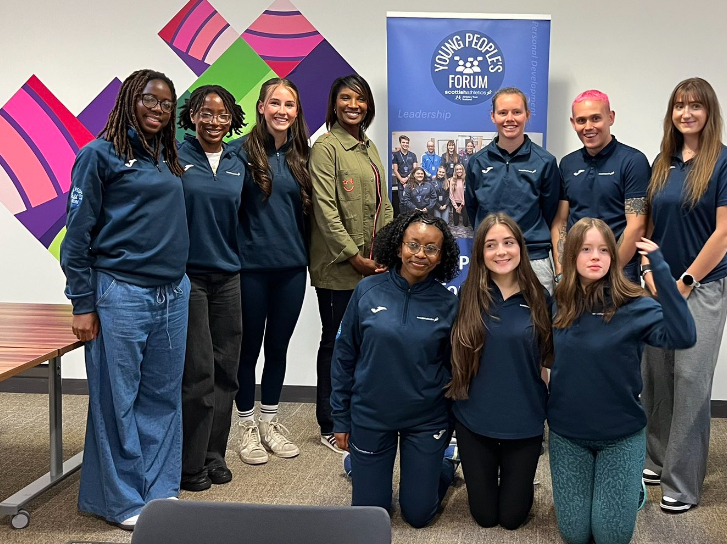
He highlights the success of Athletics Trust Scotland Young People’s Forum, a national group established by scottishathletics to give young people a platform and voice in all aspects of the planning, development, and delivery of athletics in Scotland: ‘That’s very unique because it’s not done elsewhere.’
There are also challenges and opportunities.
England Athletics have recently opted to award national medals at its championships to English athletes, or more accurately members of England Athletics.
It’s the same in Wales, Northern Ireland and Ireland; quite simply, if you make the podium and you’re from elsewhere, you’re given a championship medal at best, with the national medals being awarded to members of the host Federation. ‘It’s potentially something I’d like to realign,’ he admits.

As a coach in addition to his position as UKA vice president, Wallace, a previous recipient of the scottishathletics Volunteer of the Year award (2018), has a unique view of the athletics landscape across the UK and he is very aware of the privileged position he holds.
Despite a hectic schedule he continues to coach two groups at Cumbernauld, an U12 squad full of ‘raw enthusiasm’ and a mixed long sprints group that includes former and current national athletes and talented para-athletes.
‘The balance, as it is with every club, is ensuring we’ve got the right number of coaches in the right places and that we can focus on our athletes and supporting events,’ he says.
‘There are always bumps, we’re not always skipping into every training session, but we’ve had a very good year in terms of the number of athletes that have gone on to national programmes and have represented Scotland and Great Britain and Northern Ireland.
‘I think from grassroots up to Masters our athletes have all performed phenomenally well. It’s obviously great to sit back and look at the contribution of our coaching team and the athletes over that period, but now it’s about how we maintain that level.’

At the opposite end of the spectrum, maximising the use of AI in athletics – just one example of a project within his fascinating portfolio of work at UKA – is an ambitious but realistic goal.
In his role as UKA’s vice president, he has limited time to make an impact and he’s doing everything in his power to make that happen.
‘It’s the easiest thing in the world to highlight when something’s not going well,’ he says, a point that will resonate with many coaches as well as sports administrators.
‘The best thing to do is actually to put forward a solution; to say, ‘let’s try something, let’s evolve something’. The first cut might not be great, but let’s keep evolving it until it gets to a point where it’s usable.
‘When you take on something you always want to add value and that’s the key thing for me in this position.
‘The conversations we’re having (at UKA) are great and we’re just trying to make sure that we achieve something in the tenure that we have. That’s my goal. As soon as I feel that I’m not adding value, then it’s time for me to take a step back and allow somebody else to come in.’
+++
Tags:
Stephen Wallace