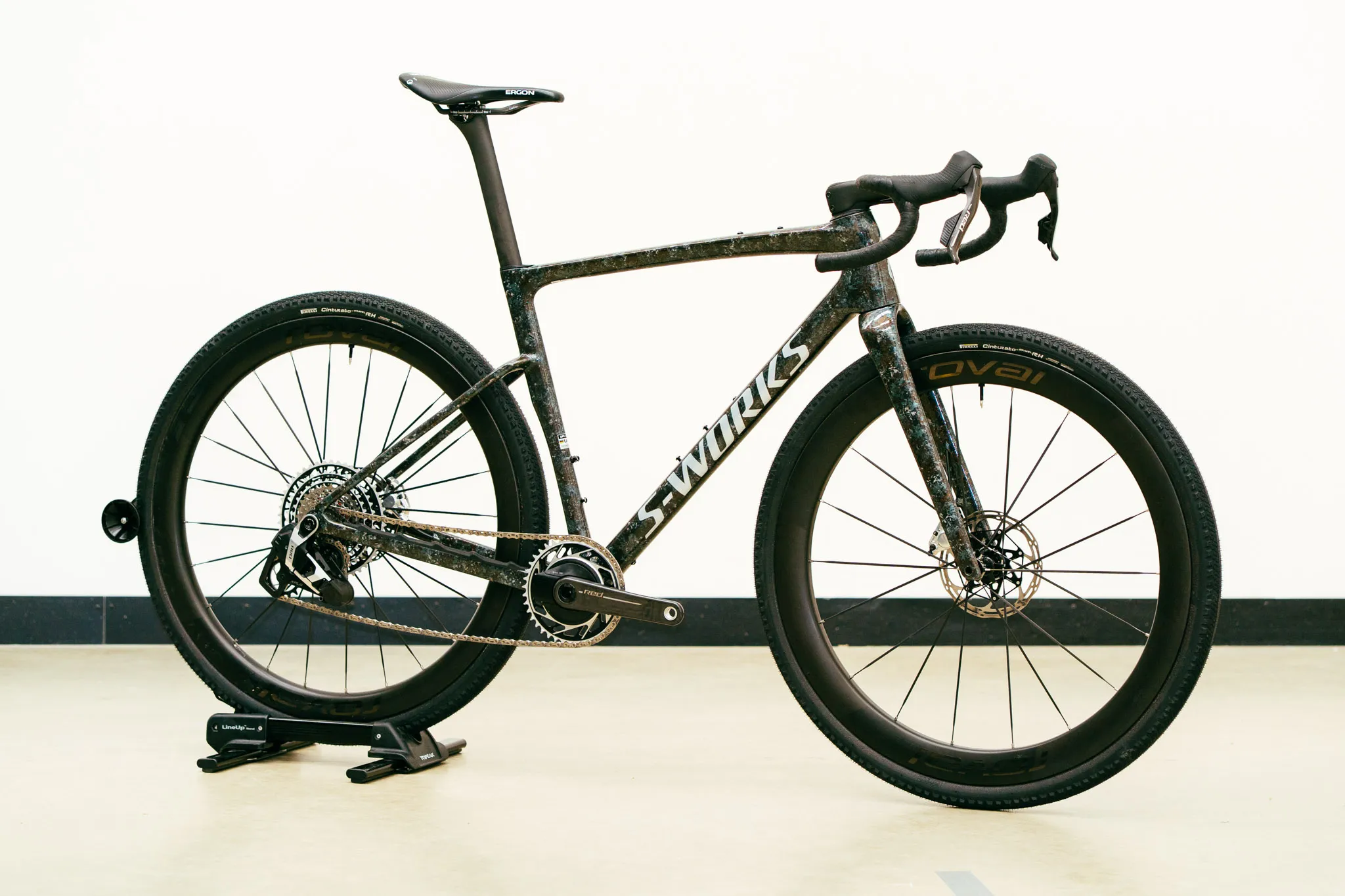
The Specialized Crux 5 had possibly the most successful launch of any bike ever.
It leaked at the Scottish UCI Gravel Worlds qualifier, the Gralloch, beneath Gee Schreurs as she rode to victory, and then after an official launch on Thursday, it took six of the 10 wide-podium spots in the Elite 200-mile races at an ultra-muddy Unbound on Saturday. For a gravel race bike, it has already proven it can race.
It was also tested among a cohort of competitor gravel race bikes here at Cyclingnews, and spoiler alert: it did well.
But before we get into the minutiae and results of that test, here are some basic details about what is still a very new bike at the time of writing. I’ll spare you a regurgitated press release and instead outline some of the headline claims from Specialized.
- It’s no longer a ‘cross bike and has instead gone all-in on gravel racing.
- It’s 15.2 watts more aerodynamic than its predecessor.
- It boasts 55mm tyre clearance front and rear.
- Builds start at 6.9kg with lightweight wheels, growing to 7.1kg for aero wheels.
- It’s mega expensive, at 14,000 US dollars for the top-spec S-Works model.
Wind tunnel testing
As mentioned, Cyclingnews had exclusive early access to wind-tunnel-test the bike against a cohort of competitors, including the Wilier Rave SLR ID2, the Argon 18 Anti Matter, the Trek Checkmate SLR, and the ever-popular Lauf Seigla.
The results are already live in our full gravel race bikes wind tunnel test write-up. But for those of you who want to focus solely on the S-Works Crux, you’re in the right place. We’ll be doing similar for other popular bikes from that test in the coming weeks, too.
Protocols and caveats
As ever, we used the wind tunnel at the Silverstone Sports Engineering Hub and, for the most part, mimicked the test conditions used in our road bike wind tunnel tests.
This means we tested each bike in a size 56cm (or equivalent), both with and without a rider, in the bike’s as-sold setup, and then again with a pair of ‘control’ wheels. We tested each bike at seven different wind angles ranging from -15° to +15° (in 5° increments), and the results below will show a weighted average.
Rather than the 40km/h speed we use in the road bike tests, we adjusted the speed slightly to 35km/h to better reflect what you’d experience in gravel races.
To caveat that, I am aware 35km/h is still fast for gravel, but we settled on this speed for a few reasons.
Firstly, to ensure accuracy. The slower the wind speed, the less force is placed on the force balance inside the tunnel, which ultimately is what measures the drag. What’s more, with lower resolution and testing with a real rider, slight movements would have an outsized effect on the result. We could have tested for longer at each yaw angle to offset this, but holding the correct position for longer has its own issues, as it can lead to more movement as the rider fatigues. Therefore, testing at as high a speed as is relevant made the most sense.
Secondly, I did some research into average speeds of entire races, and average speeds of key points within them (such as chases or attacks), and found that 30-35km/h was a good balance in competitive racing.

We used each bike as it would be supplied by the manufacturer, save for a couple of standardisations: We added bottles and cages, since that’s how riders will use the bike in the real world. We swapped the 45mm Specialized Pathfinder tyres for a 45mm Pirelli Cinturato Gravel RH control tyre to ensure no bike gained an unfair advantage from speccing slick tyres.
We removed the out-front computer mount simply because not all bikes come with one. And we swapped the S-Works Power Mirror saddle for an Ergon All Road SR. This gave us a consistent 80mm point to measure to when setting the saddle setback, and meant no bike was unfairly hampered by a 3D-printed saddle (which can catch the wind when there’s no rider sitting on top).
For the extra test using the ‘control’ wheels, we used a pair of Enve G SES 6.7 wheels shod with 50mm Vittoria Terreno Dry tyres. I feel that 50mm is a good balance of progressively wide, but not so crazy that half the bikes couldn’t fit them.
Confidence margin
The below data is subject to the following confidence interval.
| Header Cell – Column 0 |
Bike only |
With rider |
|---|---|---|
|
CdA |
+/- 0.0005 |
+/- 0.0030 |
|
Watts at 35km/h |
+/- 0.26w |
+/- 1.63w |
This is calculated by testing the same bike at the start of the day, then again at the end. Given that the same identical setup can achieve two different results, we cannot trust that any other bike is more accurate than this difference.
Results
Now, to get into the results. I will first share the raw data as it comes out of the tunnel. Then the processed data, which takes the average CdA from each of the seven yaw angles and calculates a weighted average that better reflects real-world conditions. Specifically, we weigh heavily toward zero degrees – or a direct headwind, as per the research and PHD of Cannondale’s Nathan Barry.
Bike only: Stock wheelset
The Crux doesn’t have the most aero-looking design, at least based on common convention, but it’s clearly better able to slip through the wind than the Trek Emonda ALR and most of its gravel-focussed peers.
Since there’s no rider on the bike here, a bike’s ability to harness the wind at wider yaw angles becomes clearer, signalled by how flat this V-shaped line becomes. If you check out the same graph for all-out aero bikes like the Factor One or Colnago Y1Rs, you’ll see it becomes more of an M shape, as the deep tubes help the bike to sail in the wind.
Next up, I will work out the weighted average of these data points and use it to calculate the watts required to overcome the aero drag. Those calculations won’t include things like rolling resistance, but it’s only the aero differences we’re interested in here, not the absolutes.
We’re pretty confident that thanks to the Crux’s low weight and 55mm tyre clearance, it would outshine its competitors in a comparative rolling resistance test, but such a test would be fraught with variables. It is therefore easier to measure the rolling resistance difference of tyre models and tyre widths alone, both of which we’ve done.
The above graph shows the watts required for the bike to overcome aero drag, and that the Crux is in 2nd place, just 1.21w (+/- 0.26w error) behind the much deeper-tubed Argon 18 Anti Matter.
There’s around a kilo difference between the two, but bear in mind that the Argon 18 was equipped with the slightly heavier SRAM Force XPLR.
The graph above is a slightly clearer view of the differences between each bike.
And in the graph above, you can see every bike we’ve ever tested, listed as a difference against the baseline Trek Emonda, with the weighted CdA solved for watts at 40km/h, for consistency against the road bikes.
Some context to add here is that this baseline bike is kept completely unchanged from test to test, and it is retested at the start and finish of every single test session, so the differences between it and whatever cohort of new bikes we’re testing are valid no matter when the test occurred.
Evidence that this works is that we tested the same Scott Foil in 2024 and 2025, and it performed similarly in both tests (bike-only and with-rider) over the two test days. In the bike-only test, it was 34.98 watts faster in 2024, and 35.66 watts faster in 2025; a difference of just 0.68 watts. With the rider on, it was 19.79 watts faster in 2024 and 19.15 watts faster in 2025; a difference of 0.64 watts.
Especially relevant today, though, is that we kept it in the road bike position, rather than adapting it to a gravel position. There are two reasons for this. First, the amount of adjustment needed to get it into a gravel position was impossible to achieve without a very strange stem setup. And second, road and gravel bikes do put you into a different position. By testing it this way with the road position, we could see a fairer difference in how the gravel bikes compare to the road bikes, in a way that is likely to be experienced.

Bike and rider
The ‘road’ position of the Emonda makes a world of difference to the results here, so please don’t let your takeaway be that the fastest gravel bike is a 10-year-old road bike.
But for a consistent comparison machine, it’s as good as we need, and comes with the nice bonus of allowing us to compare (loosely, given not everyone will adopt the same positions as we did) across genres.
With a rider on, the Crux lands a very impressive top spot, albeit well within the error margin of the Wilier, the Argon 18, and the Pinarello. If we couple this with the bike’s impressive weight – a full kilo lighter than the similarly-specced Rave SLR – and ample tyre clearance, it’s a very strong case for concluding the Crux is the fastest gravel bike we tested.
Here’s a clearer view of the differences between each of the bikes. The Crux and Rave are super close, separated by just 0.05 watts.
It’s very caveated by the positional difference and the fact that we’ve got gravel tyres fitted here, but as the fastest gravel bike we tested (with a rider), the Crux is the closest to all the aero bikes we’ve tested. It’s still in the region of 20 watts off the Cinelli Aeroscoop, though, and 28 watts behind its road-going stablemate, the S-Works Tarmac SL8.
When we tested gravel tyre widths, we found the difference between a 40mm road tyre (Goodyear Vector) and a 47mm Vittoria Terreno Dry gravel tyre to be 8.7 watts when using the Zipp XPLR wheels, and 6.6 watts on Hunt CGR wheels. That’s roughly what I’d expect to save if we swapped the Crux onto a road tyre, and it helps you understand the deficit in a slightly more comparable way.
With all that said, I am planning on running a more in-depth head-to-head between the Crux and the Tarmac soon. However, since a new Specialized has been spotted at the Tour Auvergne-Rhône-Alpes in recent days, I’m hoping Specialized will oblige me with the opportunity to test it against that. Watch this space.

Bike only, Enve wheels
A similar graph to the one above, but the Crux has actually dropped down the table a little, now into 4th.
When we calculate the weighted average and solve for watts, the Crux sits in third.
When we swapped in the Enve G SES 6.7 wheels and 50mm Vittoria T30 tyre, all bikes improved.
That could come down to the difference in tread between the Cinturato and the T30 tyres, but given the depth of the Enves, I’d be surprised if that’s not the real reason.
Still, in a complement to the Roval Terra Aero CLX wheels that come on the Crux, it was Specialized that improved the least, at just 2.37 watts.
Essentially, this says the Roval wheels were the closest to the Enves, in a cohort that also included 3T’s Discus, Miche’s Graff Aero, and Zipp’s 303 XPLR S.

Conclusions
As the most aero bike with a rider on, and 2nd place as bike only, the Crux 5 has held its own very well despite others here having a more obviously aero-looking design, such as the deep head tube of the Argon 18 and the integrated aero bottles of the Wilier.
Importantly, though, the Crux is a full kilo lighter than the competitors that accompany it on the podium.
Read more from Cyclingnews Labs
It weighed 7.1kg on our scales, with Red XPLR, (empty) bottles in the cages, no pedals, no out front mount, and no sealant in the Pathfinder tyres it comes with.
Under those same conditions, the Argon 18 is 8.2kg (albeit in a Force XPLR spec, as tested), while the Wilier Rave SLR ID2 is 8.1kg with Red XPLR.
With that in mind, and the fact that neither beats it on tyre clearance, the Crux is the fastest gravel bike out there right now.
That could be about to change, though, because Giant just showed off an interesting-looking contender, Factor has a new wide-tyred aero bike on the way, Ridley has what is essentially a gravel-going Noah Fast coming, and Canyon’s been busy too. Once again, watch this space.
Further questions
As ever, our testing has led to as many questions as answers. For example, I’m now curious how many watts would separate the Crux 5 and the Tarmac SL8 if we were to match the tyres and the rider positions?
Similarly, are those Roval wheels actually two watts slower than the new Enves, or is some of that down to the tyre tread? And how does the width affect it?
Likewise, what’s the difference between the Terra CLX Aero wheels and the Terra CLX III (which are shallower and weigh 261g less)?
