The Giro d’Italia Women, the second Grand Tour of the women’s cycling season, came to a thrilling conclusion at the weekend, with Demi Vollering claiming an historic victory with an all-or-nothing attack after the previous day’s Queen Stage was cut short by snowfall.
It was a win that made Vollering just the second woman to complete Grand Tour set after dropping former teammate and mentor Anna van der Breggen on the final climb of the week.
The race was filled with controversy, action and entertainment throughout the week. Here are our seven big takeaways from nine stages.
Demi Vollering secures historic victory
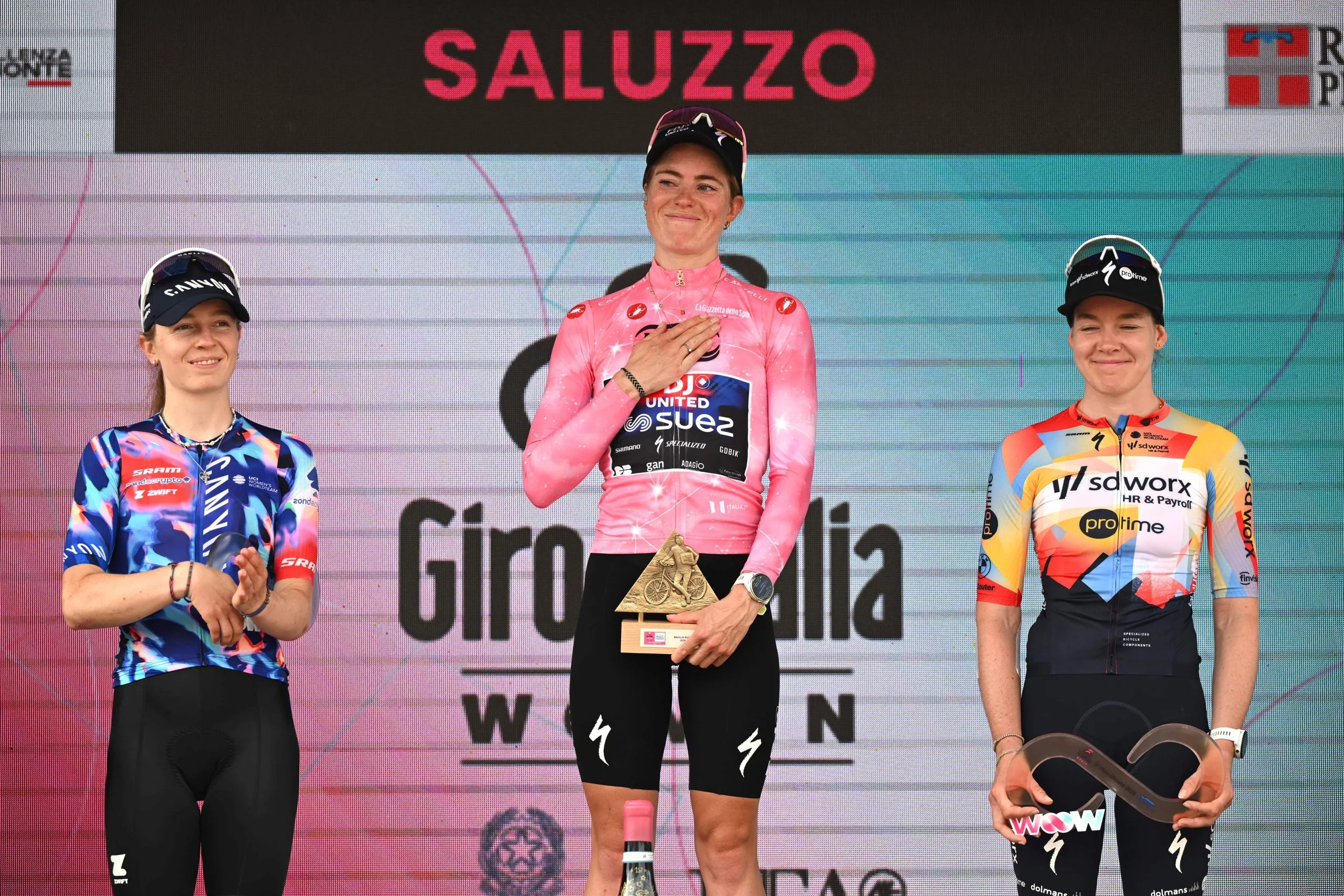
After overcoming a 49 second deficit to Anna van der Breggen on the final day, FDJ United-Suez’s Demi Vollering wrote her name in the history books. Her debut Giro victory completed the Grand Tour set having already won at the Tour de France Femmes in 2023 and La Vuelta Femenina in 2024 and 2025.
The GC came down to the final day after the much-anticipated Queen Stage over the Colle delle Finestre was shortened, and the drama was on before the TV coverage had even started. After a trio of riders including third placed Antonia Niedermaier two minutes up the road, Vollering and Van der Breggen were left wondering whether their race was over. However after Vollering’s teammate Lauren Dickson pulled the gap back enough for Vollering to reclaim virtual second place, the game was on. Van der Breggen was forced to pull and Vollering attacked on the final climb, going clear with 38km to go and soon catching the lead group with an advantage that would seal the maglia rosa.
She became just the second woman to win all three Grand Tours after compatriot Annemiek van Vleuten, and it’s now full steam ahead to the Tour, where she could just make more history as the first rider to win the Tour de France Femmes more than once.
While Vollering took the glory, her team played a big part in getting her to the right place to launch. Scottish rider Dickson was a huge engine for her leader throughout the race and ended the week with multiple top ten stage finishes as well as 11th overall. Célia Gery also did a great job in helping Vollering and also scored her first Grand Tour stage victory along the way too, winning Stage 7 from the breakaway in a sprint against Lidl-Trek’s Lucinda Brand.
Student vs master

Van der Breggen knows what it’s like to be at the peak of the sport, spending the 2010s dominating women’s cycling, including four Giro titles. She spent the final years of her pro career at SD Worx-Protime and retired in 2021 to become a DS with the team, for whom Vollering was the star rider. Now, in her second year since returning to the peloton, she finds herself competing against a rider she knows inside and out.
At the Giro, Van der Breggen won the mountain time-trial in an incredibly impressive fashion, taking over a minute from Movistar’s TT World Champion Marlen Reusser to shoot up the standings into pink, which she would comfortably hold until the final stage despite a big crash on Stage 7. In the end, she didn’t have quite enough to match Vollering’s power on the hilly closing day, but she would still finish on the podium, 1min 37sec down overall in third place.
It wasn’t a dissimilar tale to the Vuelta Feminina, where Van der Breggen lost the race lead on the final stage up the Angliru, but her Giro TT and climbing performance on the Finestre indicates she’s still picking up form as the year continues. How will she fare on the Tour’s Mont Ventoux climax this summer?
A shock disqualification

Lorena Wiebes had won the first stage of the race comfortably. The dominant sprinter was then disqualified from the race after post-stage checks found her Specialized S-Works Tarmac SL8 to be 20g under the 6.8kg limit.
SD Worx-Protime took to social media, saying that there was a ‘difference of more than 50 grams’ between the first and second weighing, saying, ‘Team SD Worx-Protime believes that Wiebes’ disqualification is an exceptionally harsh penalty. In a flat sprint stage, unlike a mountain stage, a slight weight difference provides hardly any advantage. This is especially true for a rider like Wiebes, who won the sprint in Ravenna by three bike lengths.’
The team are determined not to let the issue go, but their complaints have been met with silence by the UCI.
Following the disqualification of Wiebes, Elisa Balsamo swept up the sprint stages, taking three consecutive wins at the start of the race and a final win on Stage 6 as well as the points classification.
Antonia Niedermaier grabs first podium

Antonia Niedermaier’s time is coming. Her form in stage races this season has been exceptional, taking fourth place at Valenciana and fifth at Itzulia. Despite a crash on Stage 3 of the Giro, the 23-year-old was shepherded back into the bunch by her Canyon-SRAM squad and hauled herself up the standings with a fantastic fourth-place finish on the uphill time-trial, which locked her into overall podium from Stage 5 onwards.
That mix of time-trialling and climbing quality serves the German ITT Champion well. She raced to third on Stage 5 behind Vollering and Van der Breggen and third on the Queen Stage towards the Colle delle Finestre, all while looking very comfortable on the climbs.
It’s her best finish yet in a Grand Tour. She has been steadily improving her Giro GC results year on year, with sixth place in 2024 bested by fifth place in 2025 and now second in 2026. We all know what that means for 2027…
Isabella Holmgren and Niamh Fisher-Black level up

It wasn’t just the Balsamo show for Lidl-Trek. GC pairing Isabella Holgrem and Niamh Fisher-Black also delivered strong performances at the race. Canadian Holmgren finished seventh overall here last year and on return was highly impressive in the mountains, equalling last year’s placing after slipping down the standings from fourth on the final stage.
Her performance on the Colle delle Finestre was her crowning glory despite finishing second to Vollering on the day. She won a stage at the Tour de l’Avenir on the same mountain in 2024 and looked comfortable on the legendary climb. In addition to her solid placing on GC, the 20-year-old also comfortably topped the young rider classification.
Teammate Niamh Fisher-Black also helped make this a race to remember for Lidl-Trek with a fifth place overall. While she was a step off the main contenders on the Finestre, she climbed three places with her second place on the final day having been part of the front group from the first split.
Queen Stage shortened

The big billing for this edition of the Giro came on Stage 8: a 106km day that took the peloton over the iconic Colle delle Finestre towards a finish at Sestriere – the same double act that saw Simon Yates claim the men’s Giro title in 2025.
But as the stage kicked off, news soon filtered through that due to snowfall an unstable sheet of ice could fall onto the road at the top of the mountain. That meant the day’s racing would be shortened to 77.4km with the finish line moved to 1km before the summit of the Finestre, knocking off almost 30km of action.
With stage strategies scuppered, a group of Van der Breggen, Vollering, Holmgren and Niedermaier came to the finale together, with Vollering winning the sprint for the day’s honours over the makeshift line. A result she was pleased with but unsatisfied, given the GC stalemate that could well have been broken if the original parcours had played out.
That, however, meant that it was all-or-nothing on Stage 9 – which turned out well for both Vollering and for the fans watching on TV.
This was a very different Giro
A new spot on the calendar, a longer edition and a big mountain to tame. This was an upgraded form of the Giro that has been the culmination of many years balancing growth while trying not to cause a further divide between teams with vast budget differences.
The race’s new position at the end of May and spreading over into June instead of being held in July provides further separation from both the women’s and men’s Tours, and the 2026 edition tacked on an extra day of racing. The inclusion of the Finestre is another welcome sight too in a year that has also brought the Angliru at La Vuelta Femenina and Ventoux at the Tour this summer. Next year things are set to change even further, with the Vuelta Femenina moved to later in the year after the Tour de France, meaning it’s even more feasible for riders to take on all three Grand Tours.