Updated April 16, 2026 07:16AM
Days after one of the most chaotic and compelling editions of Paris-Roubaix in recent memory, the same question keeps popping up: What was causing so many punctures?
It’s tempting to say Sunday’s outbreak of punctures at the Hell of the North was anecdotal. Roubaix is, after all, cycling’s most unpredictable race contested on Europe’s most brutal roads.
Flats, mechanicals, and chaos are part of the landscape. But this year’s elite men’s race felt different.
The frequency, the timing, and the star caliber of riders who were impacted all hinted at something other than the usual roll of the dice over the stones.
Nearly every major contender suffered at least one puncture.
Veteran cobble-eater and former Roubaix winner John Degenkolb noticed something different in the peloton Sunday as well.
“I had the feeling that there were more problems in the peloton this year, especially with the big guys. I think that all of them at some point had at least one issue,” Degenkolb said on the team’s website.
“We all put in a crazy amount of effort as teams to get the right setup, with the recons, testing, and so on. But a day like Sunday shows that these things can happen.”
And as in every Roubaix, it wasn’t just about whether you punctured. It was when and how often.
Equipment arms race hits the cobs
Sunday’s puncture lottery came as the elite of the peloton rolled out an arsenal of innovation to tame the Hell of the North.
Wheel and frame innovation over the past decade has seen the once-wild Roubaix-only rollouts of such wacky ideas as shock absorbers and triple-wrapped handlebar tape become a thing of the past, but there was still plenty of tech on full display Sunday.
Modern Roubaix tech is now all about aerodynamics and tire selection. Several teams went with 1x chainrings as the push toward aero goes granular.
Tire width, pressure, inserts (or not), and rolling resistance were the other big talking points.
Former Roubaix specialist and now Modern Adventure team boss George Hincapie has seen the evolution up close. When he debuted at his first Roubaix in 1994, he raced on 25mm tires at 100psi.
Today? His riders at Modern Adventure raced on 32mm rubber, inflated to psi in the low 50’s.
“The tires are wider, and the pressure is less, and the handling is way better on the cobbles,” Hincapie said. “In many ways, you go faster on the cobbles, which increases the risk and the danger.”
On Sunday, some teams and riders even went wider. There were at least three teams with 35mm tires, including Pogačar.
The Slovenian raced on arguably the most unique setup in the race, 35mm on the front and 32mm on the rear. H would later suffer the punctures.
Riding wider tires on less pressure can also lead to more pinch flats and wheel damage. Punctures started early and hit just about every major contender.
As Degenkolb pointed out, teams spend weeks, months, and even years testing materials, tires, wheels, and setups trying to tame the beast of Roubaix.
Yet none of that could slow the wave of punctures on Sunday.
Fast and furious
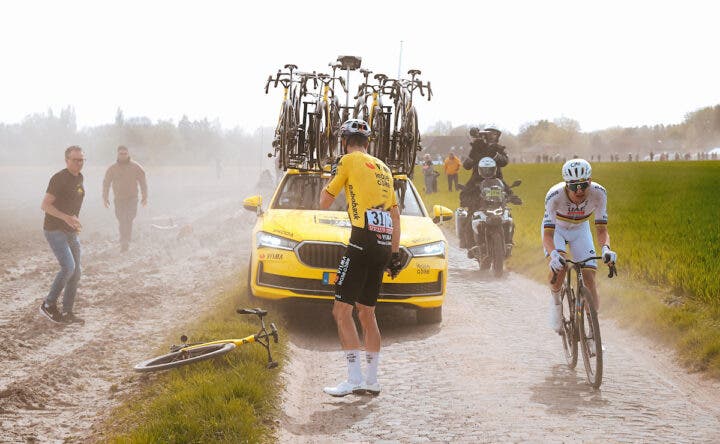
So what was driving the deflation?
Teams did final recons on Thursday and Friday, but no one expected the speed and carnage that was waiting for them on Sunday.
The most consistent explanation for the wave of punctures coming out of the Roubaix post-mortem is how brutally fast the race was.
At 48.91 km/h, this was the fastest Paris-Roubaix on record. Tailwinds, aero setups, and an aggressive race dynamic meant riders were hitting sectors at velocities that would have seemed crazy even five years ago.
As Hincapie said, faster speed leaves less margin for error.
“The speed is so much higher that they have a much harder time picking the right lines. Then it doesn’t matter what tires you have. If you’re going through a corner at 50kph, you can’t choose which stone you hit,” Hincapie said on the WEDU podcast. “They’re hitting them with far more intensity than they do on the recon rides.”
Pushed along by cross/tailwinds and Pogačar pressing the front, Roubaix’s traditional early breakaway didn’t even form.
The pack was flying by the time it hit the early sectors. By then, the punctures started to claim their first victims.
Mads Pedersen punctured early, and so did Pogačar, whose frantic chase saw him regain contact just ahead of the Arenberg.
“I think a lot of it was also down to just how high the speed was,” Degenkolb said. “Due to the speed, you’re already on your limit so much, and everyone around you is too, that you can’t really change or choose your line on the cobbles compared to if it was a bit slower.
“You basically go where you go to make sure you stay upright, and of course, by doing that it brings more risk of a mechanical or flat if you can’t then avoid some of these really nasty big cobblestones.”
Luck still counts
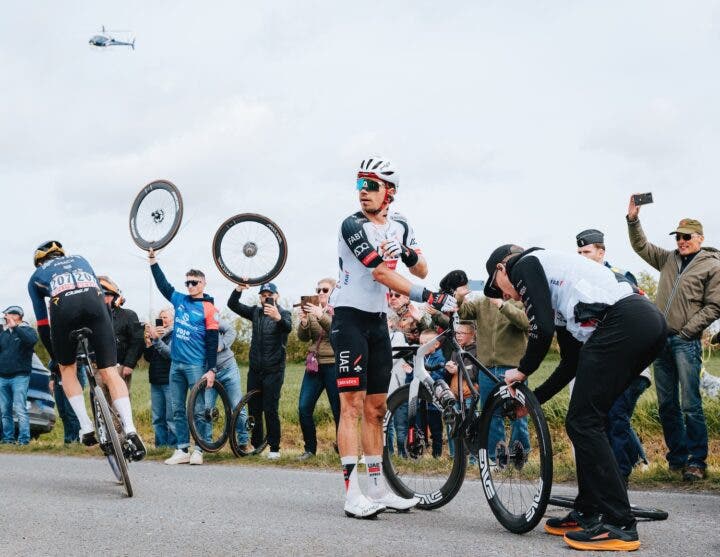
Of course, the timing of punctures is still Roubaix’s ultimate wildcard.
Take Van der Poel. A puncture in Arenberg led to a botched bike change due to incompatible pedals that saw his race unravel in an instant. Then came a wheel swap and another puncture. Incredibly, he was off the bike entirely, walking along the course, waiting for the team car.
Filippo Ganna also punctured twice, including a second flat and crash that saw him lose contact in the lead chase group that had whittled the gap down to about 30 seconds. Losing his big engine would play out across the final hour of racing.
Did punctures cost Pogačar the historic win on Sunday that could have given him the monument sweep? Probably.
Pogačar punctured three times: twice before the Arenberg and once after.
Chasing back in the ensuing chaos and even being forced to ride a neutral support bike that he called a “wheelbarrow” left him with “spaghetti legs” as he rode into the Roubaix velodrome. Pogi had nothing left for the final sprint.
Van Aert also punctured twice, riding on a tubeless setup after the UCI banned its Gravaa tire pressure device just weeks before the race.
For once, luck shone on Van Aert. His punctures came early enough that he could fight back through the carnage and still battle for the win.
Sunday’s wave of punctures came due to the peloton’s double-down bet on speed and aerodynamics colliding with cycling’s most brutal roads.
That’s the paradox of Paris-Roubaix — no matter what cutting-edge technology the peloton might produce, the cobblestones always have the last word.