Updated March 24, 2026 09:35PM
The best professional cyclists don’t always get to choose what they ride, even though it seems as if they are always on perfectly dialed equipment that meets their every need.
In reality, it is a combination of push and pull, with sponsorship decisions and requirements often superseding athletes’ desires. Compromise is all over the kit choices of professional cyclists, and nowhere is this more present than for athletes who are sponsored by the biggest companies with the widest slate of products.
Specialized and its factory teams are the primary case of this. Specialized is fundamentally a bike company that makes bike frames. Yet, Specialized is also a wheel company, a shoe company, a helmet company, a clothing company, and a tire company. Athletes come to the brand for the bikes and the expertise, and in return, they use all the other stuff as well, even if they would prefer to use other products from other brands.
This means that in gravel cycling, Specialized tires have increasingly become very important for the outcome of racing. That is because five of the top men and women gravel racers in the world have to run them, including Keegan Swenson, who just joined the brand’s team earlier this year, Sofia Gomez Villafane, and Matt Beers.
From early anecdotal evidence, the Specialized Pathfinder TLR 50mm tire is going to be the most popular option for Swenson, Beers, and Villafane as they race the biggest gravel races in the world.
While they are stuck with the tire, whether they like it or not, you and I have a choice. So I thought I would give the tires a try and see if they are worth riding if you don’t have to. Through both racing at the recent Mid South Gravel and riding around my local terrain, I found to loved them. But for others, I would urge caution.
Quick hits: Five things to know about the Specialized Pathfinder TLR
- The Specialized Pathfinder TLR is a revamped version of the old Pathfinder Pro, with more width options, a new sidewall construction, and improved rolling resistance.
- The tire is one of three gravel tread patterns from Specialized — the others are the Tracer and the Terra — and it is available in 35, 40, 45, and 50mm.
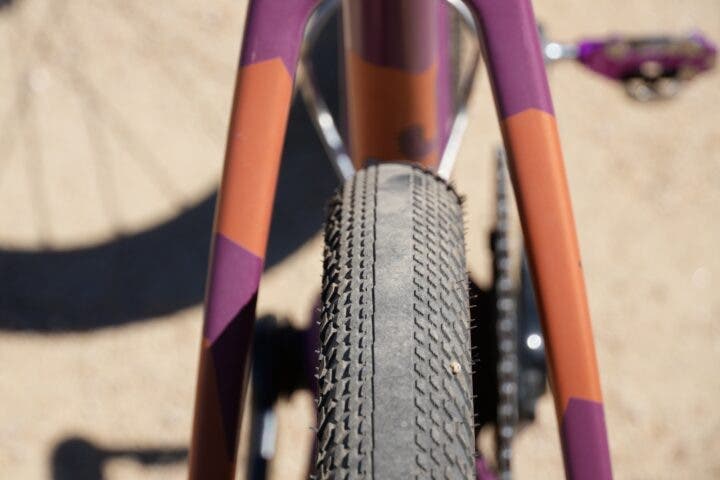
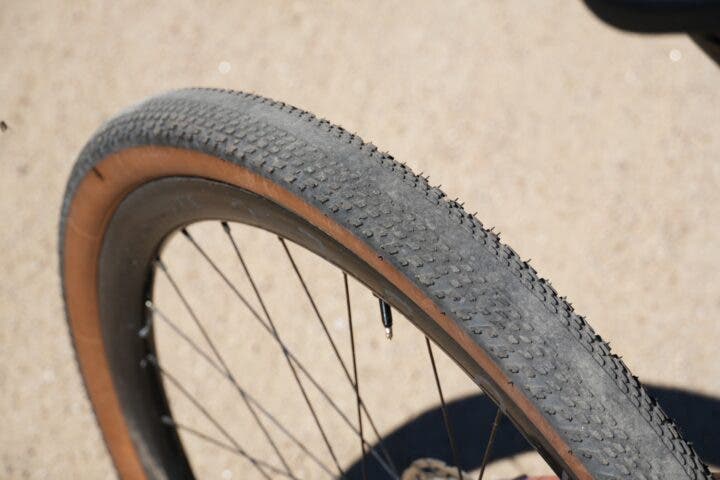
- The Pathfinder uses a wide center strip with small side knobs for traction.
- Specialized Gripton T2/T5 for the rubber compound and a 60TPI 3-ply TLR casing.
- In total, the tire weighs 580g for the 50mm size and have a MSRP of $64.99.
For more information, check out the tire page from Specialized.
High upside, especially for light gravel
The Specialized Pathfinder is a legacy tire in the world of gravel, if there is such a thing, as the tire was the go-to tire at Unbound in 2021 and 2022. Back then, it was the 40-42mm width that was the most popular, with three of the top five men in the race running 42mm Specialized Pathfinders.
Ultimately, the Pathfinder faded from the top of the de facto gravel tire power rankings as tire volume started to rise for the top racers. Likewise, the tire choices of many started to shift to mirror the professionals who began to turn to lightweight mountain bike tires like the Schwalbe Thunder Burts, the Maxxis Aspen ST, and the Continental Race Kings.
While those large-volume tires are still popular, there is still no definitive, clear-cut evidence that the mountain bike tire is always the fastest option for gravel racing. And for many, including pros, frame sizes are still limited.
That trend has led to a new slate of 48-50mm gravel tires that have tried to marry the weight, aerodynamics, and geometry gains of traditional gravel tires with the undeniable rolling resistance benefits that come from more tire volume. The new and improved Pathfinder TLR at 50mm is a case in point for this trend. While it isn’t alone in the Specialized line-up, the Terra and Tracer have different tread patterns that cover the same dimension; it is the one that seems to be most popular for racing since it is the fastest rolling option out of the three.
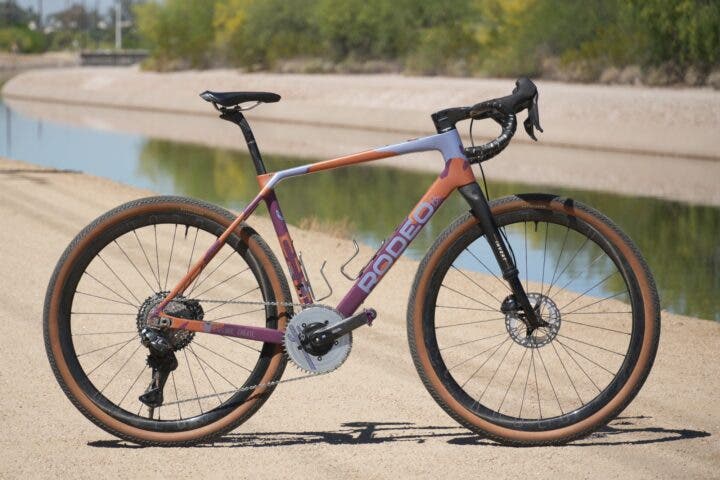
Anecdotally, I can see why. The Pathfinder feels quite rapid over a wide variety of surfaces, especially pavement and hard-packed gravel. I have been running the tire for around a month, and I have found it to be one of the quietest gravel tires I have ridden on pavement. Sound isn’t a perfect test of speed, but it is not unimportant, as sound often reflects some other variable that could be causing drag — whether it be air or rolling resistance. In the case of the Pathfinder, that silence is aided by its large center-click tread and fairly pliable sidewalls.
Specialized also claims the new TLR tire compound is faster than its predecessor, with a stated speed improvement of 19%. While we cannot verify that, especially since the 50mm option was only introduced last March, my impressions from a few hundred miles of riding are that Specialized has been able to make a fairly rapid tire in a package that is also lightweight and reasonably flat-resistant. Exactly how durable is another question — Specialized also lists the Pathfinder as 14% more cut-resistant than previous casings — but we have yet to see anything to conclude otherwise, as the tire has withstood numerous tough desert rides and 100 miles of gravel racing in Oklahoma.
Speaking of racing, I tested the Pathfinders at the Mid South Gravel race in Oklahoma, which is known for its hard-packed red dirt roads, constant climbs and descents, and occasional mud. For all of these reasons, the Pathfinder seemed like a perfect tire to race on as it has been championed as a great hard-pack tire from its days as the king of the 40-42mm range. The Pathfinder’s semi-slick construction also makes it lightweight, helping on the climbs, and resistant to sticky mud.
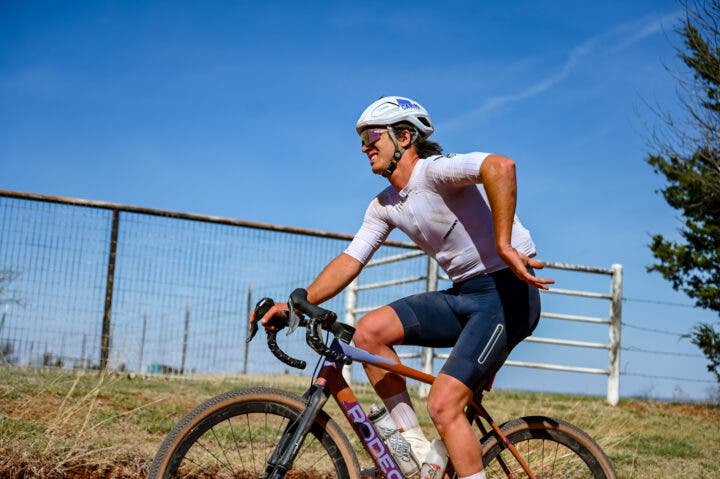
In the end, my race wasn’t the most successful, but that wasn’t an issue with the tires. Paired with a Cane Creek Invert fork, the Pathfinder felt rapid throughout the race, handling the high speeds well and being dynamic enough to meet the moderate technical demands. I will cover more of the downsides later, but as a racing setup, I saw the metaphorical vision of this tire as a super-sized road option, built for straight-line speed on easy to moderate gravel.
Using that as a yardstick, it is clear to see why this is a tire that the best in the world are willing to ride. For racers, the Pathfinder might find its way back onto many race bikes, especially at the events where pavement is more frequent and turns are more limited.
New gravel cyclists beware, the Pathfinder rewards experience
All those positives aside, the Pathfinder TLR is not for everyone. The tire operates on a few key thresholds that some riders simply won’t want to put up with.
Notably, the traction of this tire is very, very limited.
Even compared to the previous version of the Pathfinder, in all of its four-centimeters of glory, the new 50mm version feels very slick. It does have side-tread, hence the semi-slick designation, but in my experience, it might as well have skipped those. The tire functionally is much more similar to a fully slick tread than it is to a Vittoria T30, which is a lot more effective at engaging its side knobs than the Pathfinder.
Over the course of my riding, which ranged from the hard-pack of Oklahoma to the sinuous trails of the McDowell Mountain Preserve outside of Phoenix, Arizona, when the Pathfinder starts to drift, it doesn’t bite in the same way as other semi-slicks do. When it goes, it really goes.
That being said, riders like Swenson and Villafane have both talked about how they enjoy a tire that slides. If you understand the physics of it, a two-wheeled drift can be an incredibly effective tactic to find your way through loose turns where even the knobbiest tire will come unstuck at certain angles and speeds. The slide can be more predictable overall.
As a long-time gravel and mountain bike rider myself, I am not above a one or two-wheeled drift — in fact, in Phoenix, I feel more comfortable than I should with that method of handling, given the density of cacti — but that isn’t something that the average gravel rider will feel comfortable with. That, paired with very low braking traction from the large slick center tread, makes this tire seem like a pretty poor option for cyclists who are not multiple years into their off-road riding careers.
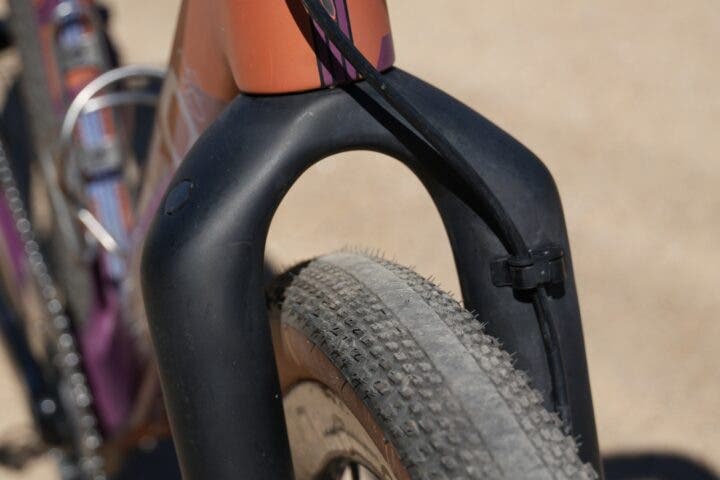
One last tricky aspect of the tire is the narrow pressure range where the tire functioned well. With the very limited tread pattern, any pressure over 30 PSI felt rough and all semblance of traction was gone. Nevertheless, the low end of the range of pressure listed on the tire was 25 PSI, making the acceptable range a very tight window for me, an 80-kilo rider. For others who are lighter, I would say that 25 PSI floor is pretty conservative. If you are anywhere in the 50-70 kilo range, I would say your best success with the 50mm tire would certainly be below 25 PSI.
Yet for me, I could only drop one or two PSI below that point before the tires’ lightweight sidewalls fought back, and I would feel them start to fold around certain corners. Ultimately, the Cane Creek suspension fork was a huge benefit to the tires since it allowed for a bit of firmer pressure while still having a comfortable ride and traction on bumpy corners.
That being said, if I had a fully rigid setup that narrow pressure window could have been a real downside that might have influenced my choice to run those tires at an event like Mid South,
Value and conclusion
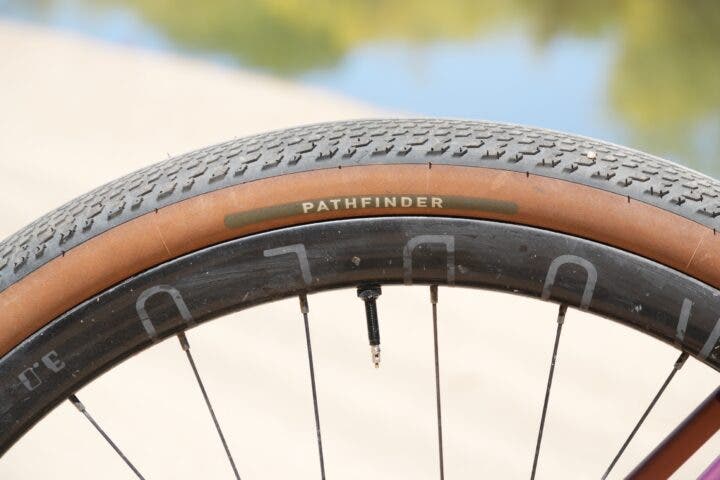
Overall, the best thing about this tire might be the price. At $65 USD, the Pathfinder TLR is the cheapest tire I would trust at a race. We could go through the list and parse through which tire comes closest, but at $65, it is significantly cheaper than the other tires most professionals will be lining up at the biggest races in the world with.
I would say that the added price will get you some added performance with a few options, but without getting into all those nitty-gritty details here, it is safe to say the Pathfinder TLR is one of, if not the best, value gravel race tire on the market.
Ultimately, a quirk with this tire is that normally the best value tires are also the best for beginners. They are the products where the price point is low enough not to scare off enthusiasm for the sport, while being good enough to produce a good time at the races. The Pathfinder is not one such case. I would urge new gravel cyclists to avoid this tire and instead try the Specialized Terra, the other Specialized option. (Note: there is also the Tracer, but from my riding experience, that tire has most of the same limitations as the Pathfinder, but without the gains of the semi-slick tread pattern.)
Yet, for an experienced gravel cyclist — with a need for speed, a frugal wallet, and a smidge of risk tolerance — you can follow the lead of Beers, Swenson, and Villafane; it’s good enough for them, and it’s good enough for you.