All eyes were on Tadej Pogačar as he lined up for Milan-San Remo last weekend. But not in the typical, we know exactly how this will play out, way. Far from it. The race had evaded his ruthless clutches over the years, yet Pogačar returned, like a stubborn dog with a bone, to cross this one off his list.
When he finally achieved the feat, it proved to be his grandest one yet. But why this slog of a Monument as opposed to his World Championship titles, maillot jaunes or even fifth commanding Il Lombardia win? Let’s discuss.
Limiting parcours
Pogačar is an extremophile, much like a Pompeii worm or Antarctic nematode, an organism that thrives at the point of intensity others suffer and break under. Yet while he embraces the pain of a lengthy breakaway, this does not suit the DNA of Milan-San Remo. Its parcours lends itself to the fast men. Over the past two decades, the race has ended in some form of sprint 75% of the time.
The first climb of the Passo del Turchino is nothing more than a speed bump before the peloton quickly reverts to flatland until the final 50km where the Tre Capi hit in quick succession. These climbs are small. The Capo Cervo, the longest of the three, is only 2.1km in length, meaning it acts as less of a springboard and more of a reminder that the Cipressa is incoming.
The Cipressa is the first in the 1-2 double punch combination that contains all the day’s major action. At 5.6km in length, it offers an average gradient of 4.1%, with a maximum pitch of 9% around 2km from the summit. This is where Pogačar launched a bid for glory in 2025, ultimately drawing out Mathieu van der Poel and Filippo Ganna for the final 22km. Both would beat him in the sprint finish, but an attack here can be thwarted too thanks to the flat section that lies between it and the Poggio.
The 3.7km-long Poggio is the final climb to contend with and is similarly short in length. It peaks at 8% and crests just 6km from the line, so it can be hard to gain any sort of advantage, especially when the sprinters want to justify a near 300km in the saddle.
However, a pattern has emerged in recent years as riders shift towards playing their hand here as opposed to waiting for a bunch sprint. Vincenzo Nibali, Matej Mohorič and Mathieu van der Poel have all achieved glory by either attacking on the ascent or using the technical descent to gap the field.
Pogačar tried this himself in 2024, yet Van der Poel clung onto his wheel like a loose wrapper stuck in the spokes, a small group eventually becoming the leading contenders. Pogačar’s odds crumbled as a sprint finish came to fruition. Not for lack of trying though. He still managed to come away in third behind Jasper Philipsen and Michael Matthews.
A Monument calls for big names
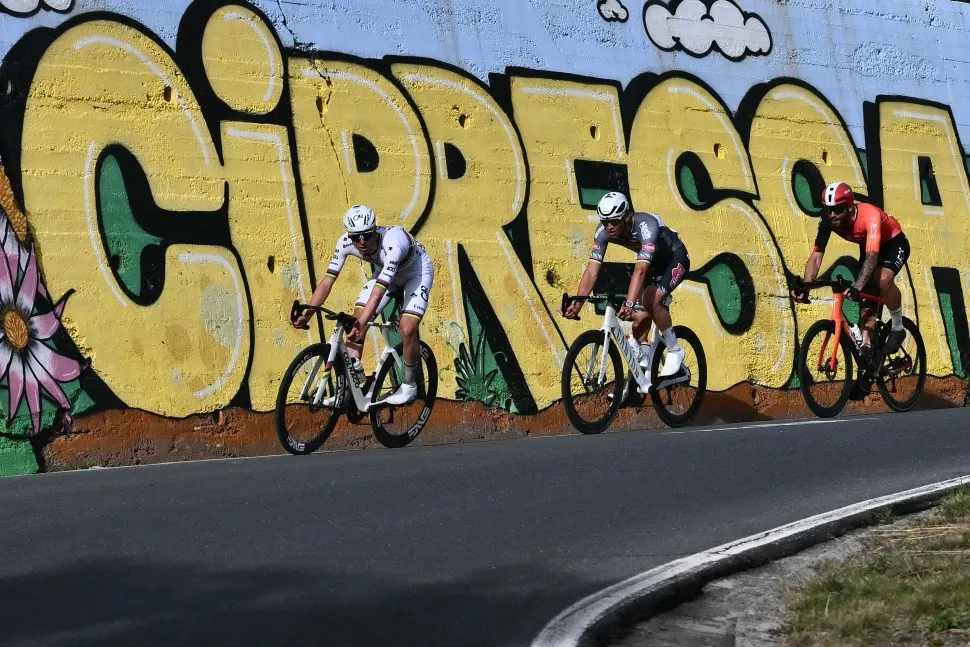
Pogačar is in a lane of his own. There’s hardly a race he enters where his name isn’t marked down as one of – if not the – favourite, which is why Milan-San Remo was something of a conundrum. His inability to drop key names in prior editions was his downfall, particularly Van der Poel.
The race suits sprinters and also brings strong Classics and rouleur types to the fore, attracted by the opportunity for splits off the Poggio. Van der Poel has won here twice before, and the Monument packs an honour roll that includes Mohorič, Jasper Stuyven, Wout van Aert, Julian Alaphilippe and Michał Kwiatkowski — men known for their Classics capability as opposed to sprinting prowess. It’s a hard job for one man to overcome a field that contains these names in such a short distance and with so few climbs to contend with.
This year, Van der Poel was expected to stay with Pogačar, yet was dropped on the Poggio. Pinarello-Q36.5 Pro Cycling’s main man Tom Pidcock could keep up though, hot off the back of his Milano-Torino win, and narrowly lost out in the sprint. A penny for the thoughts of Pogačar who, after shaking off his biggest rival in the Dutchman, then turned around to see one of the sport’s greatest descenders on his wheel for a technical downhill.
Brandon McNulty to the rescue
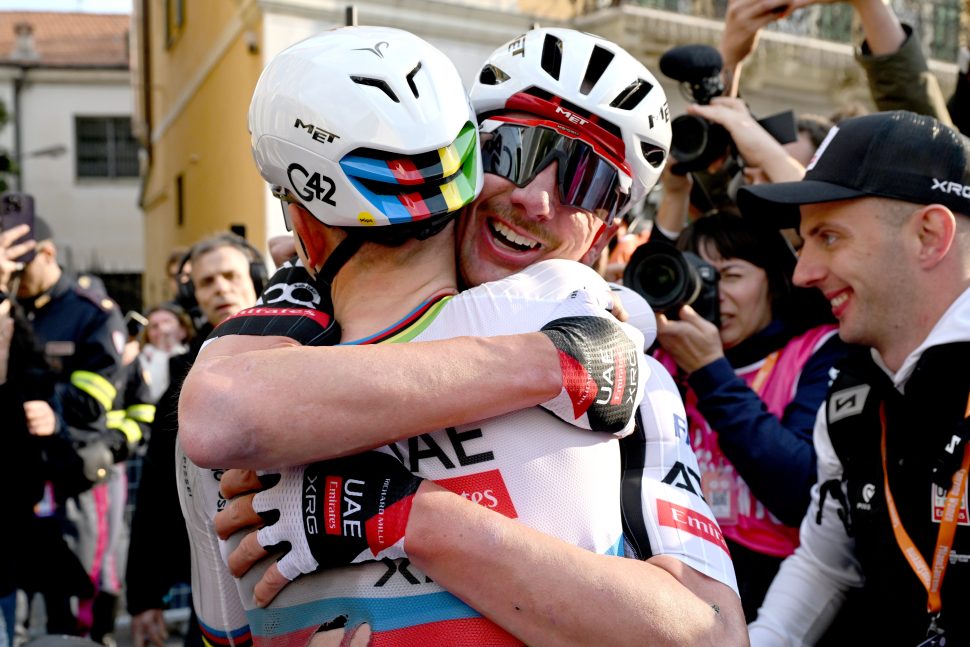
Milan-San Remo is an individual victory, but also the result of team cohesion. Just look at Silvan Dillier, who spent almost 200km pulling on the front of the peloton for Alpecin-Premier Tech.
Things can get disjointed quickly, as UAE Team Emirates XRG can attest to. On the Cipressa last year, Tim Wellens led the way and Pogačar was pushed up to the business end of things by Jhonatan Narváez, the Ecuadorian teeing up his teammate for an attack close to the summit. However, both men found themselves sidelined through injury this year, meaning others had to step up and fill some pretty important cleats.
A crash on the run-in to the Cipressa set the cat amongst the pigeons this year. Pogačar and Van Aert were two big names to hit the ground, with the former’s skinsuit ripped and red wounds exposed. A glimmer of good fortune was welcomed though, as he was back on his bike quicker than most. Brandon McNulty earned his keep (and then some) by powering through the peloton to position his teammate near the front. Isaac del Toro then put in one last dig and Pogačar launched, drawing out Pidcock and Van der Poel.
It was surprising to see Van der Poel distanced a few kilometres later on the Poggio. This was a man who thrived at Milan-San Remo, clearly in the form of his life, having dominated winter cyclocross and his road return at Omloop Nieuwsblad. To see Van der Poel fade into the distance was an uncharacteristic abnormality. Close-up photographs would later confirm it was not the result of poor form, but rather an inability to properly clench his handlebars following the crash.
It played into Pogačar’s hands too that he and Pidcock worked well together on the descent of the Poggio rather than looking at or attacking one another. Van der Poel later conceded to Het Nieuwsblad that ‘on the Poggio, I rode at my own pace like Ganna last year. Unfortunately, Tadej and Tom didn’t look at each other.’
Great expectations
Some races are almost a foregone conclusion when Pogačar enters. We could accurately pinpoint where his long-range move would come at this year’s Strade Bianche (the Mont Sante Marie section of gravel, around 80km to go) and, as much as people soak up witnessing greatness, there’s little satisfaction in being unsurprised. Cycling is, at its peak, great entertainment.
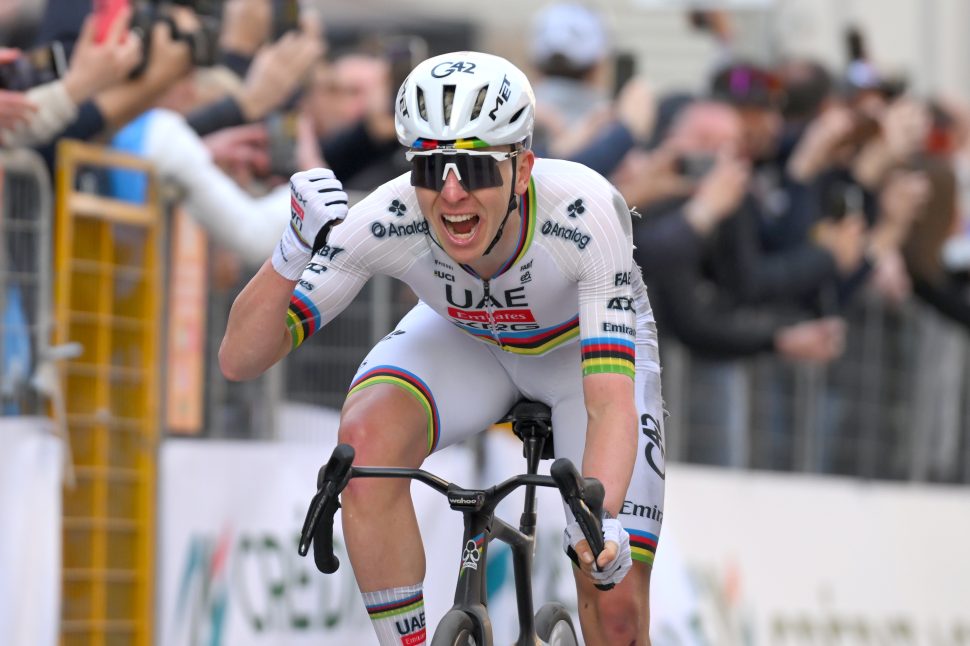
Which is why this element of unpredictability helps our case in favour of Milan-San Remo being Pogačar’s finest win. Even after all this time, all the victories and titles he has amassed over the years, he can still surprise. His celebration took a different form as well. The world champion, ripped rainbows and torn skin, hunched over his handlebars, having to look over to see the location of his two-up sprint partner Pidcock before he could let out a roar in jubilation.
Perhaps it’s not a shock that Pogačar eventually won Milan-San Remo, given his commendable insistence on slotting La Classicissima into his palmarès, rather than the manner in which he did so. Having to recover from a crash, the chaos of repositioning onto the Cipressa, the team’s plan somewhat out the window, fuelled on a mass of adrenaline and after bringing another strong contender to the line with him. He admitted to feeling it ‘was all over’ after the crash. Yet with his back against the wall, he embraced the chaos to win the elusive.
Paris-Roubaix is the only Monument left standing. It surely won’t be long until that falls too.