The explosion onto the WorldTour scene of Decathlon-CMA CGM’s Paul Seixas may have begun in 2025, but his stratospheric trajectory into the spotlight is exceeding expectation and providing one of the driving narratives of the 2026 season – just his second in pro cycling. It’s a season in which he will convert hope and excitement into the first meaningful marks on his palmarès, if all goes according to plan.
The celestial body around which the future of men’s cycling orbits, the gravitational pull of Paul Seixas – on the media, the fans, teams – is inexorable. Particularly in his homeland of France. They are the east and Seixas is the sun, and his light is breaking through yonder window with such dazzling brilliance, many of the season’s other storylines are cast into shadow. The hype is not unjustified.
Following his promising first season, in which he finished on the podium at the European Championships Road Race following an impressive 13th at the World Championships in Kigali and followed by an even more impressive seventh at Il Lombardia, Seixas is laying the foundations for a potentially astonishing future – one which, if it unfolds according to early portents, will provide the eagerly anticipated sequel to the history currently being written by Tadej Pogačar.
The primary question, at least until last weekend, concerned Seixas’s participation, or lack thereof, at the 2026 Tour de France. Despite hints from L’Équipe last week suggesting that the 19-year-old will indeed make his debut at the race in Barcelona in July, there’s been no official confirmation from his team thus far, and it’s unlikely to be announced for a while longer. In the meantime, we exist in a scenario that appears to be living rent-free in the heads of the cycling media and fandom at large. Like the famous Schrödinger’s cat hypothesis – in which a cat resides in a closed box with a vial of poison and can be said to be both alive and dead, existing simultaneously in both states until the box is opened and the actuality is confirmed – currently we exist in a world where Paul Seixas both will and won’t ride the 2026 Tour de France.
Of course, the same could be said of many riders, about many races. But this particular uncertainty rests on a fulcrum of great significance, as it concerns the potential first contact between a rider whose destiny is already intertwined with the biggest race on the planet. Unsurprisingly, it’s generating a wealth of speculation and whatever the team plans to do vis-à-vis an official announcement, reaching a decision sooner rather than later would at least remove the need to continually answer the same question from a raft of highly invested parties. It should be noted that Seixas now has a personal dedicated press officer, presumably to head off some of these queries at the pass. Perhaps they would be wise to enlist the services of whichever canny web developer put together the simple yet ingenious website ‘is Milano-San Remo exciting yet?’ which returns a response of ‘no’ until the exact moment at which no one in their right minds is heading to the website to see the ‘yes’ response, as they are, of course, too busy enjoying the frenetic excitement of arguably the best 20 minutes of the season.
The equivalent ‘is Paul Seixas riding the 2026 Tour de France?’ could return a ‘we don’t know yet’ or ‘yes’ response, but as rumours mount, and Seixas continues to attack the season with the reckless abandon of an athlete who knows they are on the fast-track to stellar success, the question becomes more one of ‘why wouldn’t he ride the Tour in 2026?’ While those with a more measured head on their shoulders may urge him to wait a bit longer, the vox populi is amplifying and the possible outcomes slide along the scale from ‘maybe’ to ‘probably’ to ‘yes, obviously, even though they haven’t actually said so yet’. Most young riders begin their Grand Tour career at La Vuelta, the most laconic and least spotlighted of the three. Yet something about the arrow-straight path that shoots out from Paul Seixas towards his almost irrevocable destiny seems to be dragging him closer to a 2026 debut. Why wouldn’t he want to give it a shot at the earliest opportunity?
Collapsing possibilities
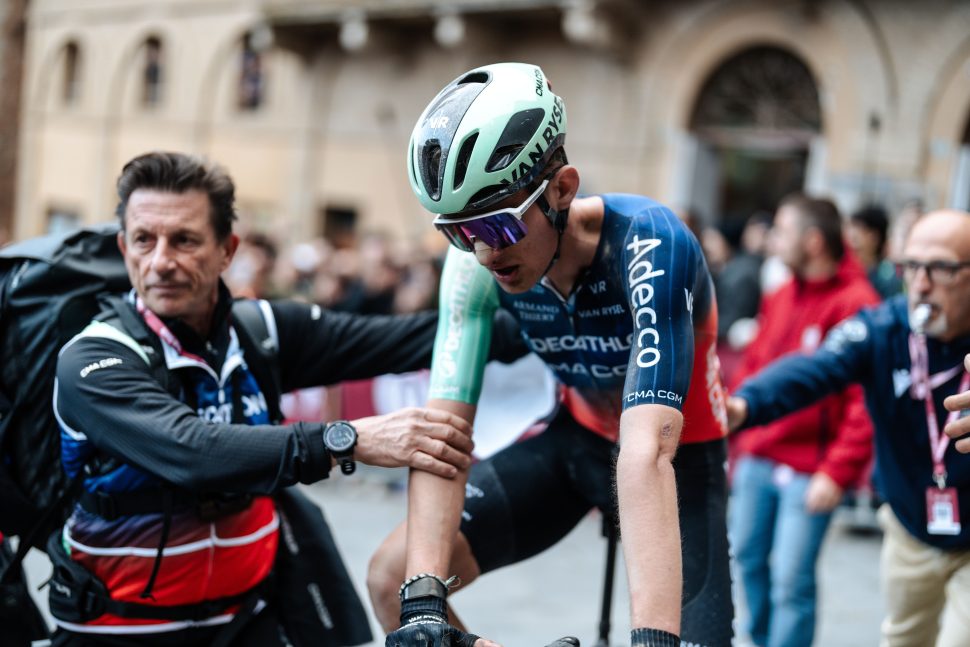
Why is the uncertainty over whether Seixas will pop his Tour cherry at the tender age of 19 causing such an intense frothing at the collective mouth? Perhaps it’s because we’re all desperate for a ray of hope that the battle for the yellow jersey might be competitive once again – even if we do have to wait a couple of years. All evidence points to him being able to keep up with the top names in the sport during one-day races – but three weeks is an unknown quantity. Would it be different if he weren’t French? Yes, probably. The yearning of the French for a successor to Bernard Hinault is keenly felt, rippling beyond the homeland every July as noble efforts over the years from the likes of Thomas Voeckler, Julian Alaphillippe and Thibaut Pinot continue to fall short.
To return to the quantum mechanics metaphor, once Seixas, or his team, lift the lid on the metaphorical box, thereby collapsing the superposition into one definitive state, a new question will be posed: how far can he go this year? The hype will be great when the confirmation eventually comes, because Seixas’s whole career is building towards this point of inevitability: that he seems destined to win the Tour de France.
Paradoxically, the more arguments that stack up around the ebullient prodigy, both for and against, the less important the final decision becomes. If he goes, his participation will be imbued with the deepest significance on both a romantic and a pragmatic level. The chance for him to take his first measurements over three weeks against the best the sport has ever seen; opening his account at a race that has come to define his nascent career, even before he has ridden a pedal stroke in anger on the metaphorical yellow brick roads that lead to Paris. Shaking off the nerves with zero pressure to actually achieve anything, as his team will protect him from expectation, and lean on sprinter Olav Kooij – should he be fit by then – to spearhead the team’s Tour campaign in his hunt for the green jersey. If he doesn’t go, then he probably will next year, with even greater expectations, and the cycle begins again.
The UAE Entanglement
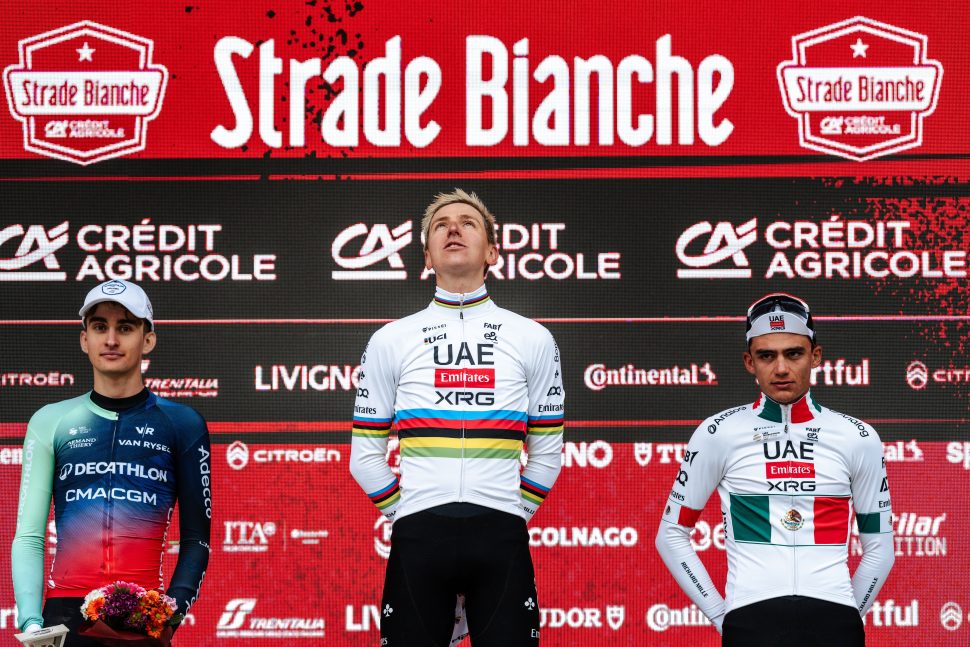
When I first began writing this article, it was solely to debate the will-he-won’t-he of the Tour de France question. With the increasing likelihood that Seixas will go to the Tour, the discourse has already moved onto transfer talk. The second element in the Seixas uncertainty principle, is the future of the rider in relation to his team. With his contract with Decathlon due to expire at the end of 2027, teams are now allowed to approach to indicate interest, and no doubt many have and will. Consequently, we now exist in a world in which Seixas will, and won’t, ride for UAE Team Emirates at some point in his future. He will – and won’t – become the first Frenchman in 40 years to win the Tour de France, riding for a French team.
The distinction is significant, and strikes far closer to the heart of what is wrong with men’s cycling in the present day. Consequently, the decision that is made will define the sport at its top level for the foreseeable future.
To draw out the (admittedly flimsy) analogy, Seixas’s future cannot be considered independently from that of UAE, even if they are currently separated. The entanglement in question here is that of every elite GC rider being heavily linked with, if not actually riding for, the richest team in cycling. The team has limitless funds and the lion’s share of the world’s top GC riders have been clustered at the team for the past couple of seasons, with João Almeida a solid second-in-command behind Pogačar, Juan Ayuso improving to the point where he deemed himself surplus to requirements and moved on to Lidl-Trek, and Isaac Del Toro’s star rising so rapidly he almost won a Grand Tour in 2025.
Despite this embarrassment of riches, plenty of logical arguments could be made for Seixas moving to UAE: they can offer him the support of the strongest army of domestiques ever assembled. He would be following the legacy of the greatest rider of the current generation, probably ever, learning from Pogačar and benefitting from all the wisdom gleaned from several years of the team competing at the absolute top level of the sport. He’d become one of the most well-paid riders in cycling. The question remains: could he exist on the team alongside Del Toro, who arguably represents his primary future rival, once Pogačar decides he’s got enough Tour de France wins to be going on with? Could there be a superposition of two such powerful forces? Having them both on the same team feels absurd, but that is where cycling is heading, with such a dominant team in control.
At this point, Seixas’ apparent entanglement with UAE is theoretical. Yet, to open the metaphorical box and see Seixas in a UAE jersey would arguably collapse the concept of romance in cycling, crushing it into a state of quantum non-existence, and forcing French fans to confront the reality of seeing one of their own achieve the holy grail of cycling prizes, riding for a non-domestic team, the one that was already dominating pre-Seixas. It would leave cycling fans devoid of hope that any other team could compete, despite the increase in funding for Decathlon themselves, as well as the likes of Red Bull-Bora-Hansgrohe, Lidl-Trek and Ineos.
Choose your own adventure
I’m painfully aware that this piece adds to the growing metanarrative constructed by the cycling media around the avoidance of putting pressure on young riders, while simultaneously spotlighting them at every given opportunity. Seixas has inadvertently ridden himself into a pressure cooker of external opinion by virtue of being young and French and brilliant, but whichever possible path you choose doesn’t really matter. The hype around him is just noise. His legacy will still be written, in one way or another, his name forever tied to the Tour de France, and the prophecy that he will become the first Frenchman in over 40 years to win the Tour will persist for the duration of his career. It could branch off in multiple directions…
Paul Seixas rides the Tour in 2026
He challenges Tadej Pogačar and Jonas Vingegaard on some of the key GC stages but ultimately finishes in the top ten. Cause for modest approval.
OR he loses a lot of time on purpose in week one then triumphs on Alpe d’Huez. Pogačar wins the GC but Seixas has a decent run in the polka dot jersey and France is in raptures.
OR he starts out with his usual youthful exuberance, then fades and DNFs in week 2. Cycling commentators call it a cautionary tale. He fades in the back end of the season and Decathlon are accused of putting too much pressure on too soon.
Paul Seixas avoids the Tour in 2026
He heads to La Vuelta instead, winning at least one stage and making the top five on GC. Comparisons with 2019-2020 Tadej Pogačar abound ahead of 2027 Tour de France, which he will be expected to win in dramatic fashion on stage 20. The route designer adds La Planche des Belles Filles to the course.
OR he puts off his Grand Tour debut for another year and the hype and expectations in 2027 are a bigger story than the Tour itself.
He signs for UAE Team Emirates in 2027
Isaac Del Toro steps up another level and Seixas plateaus. He’s used as a deluxe superdomestique and reminds us yet again of the dangers of overhyping teenagers. He signs for Cofidis in 2031 and never wins a Grand Tour stage.
OR he assists Pogačar to a record-breaking Tour win, Del Toro goes the way of Ayuso to compete and Seixas takes over Giro and Vuelta duties while domestiqueing at the Tour until either Pogačar retires, the UAE pulls their funding or a new super-sponsor emerges to buy him out.
He extends with Decathlon
He wins the French National Championships in 2027, follows up with five straight yellow jerseys and ascends to the history books as the true Messiah of French cycling.
He wins the World Championships in Montreal and wins the 2027 Tour in the rainbow stripes
He turns out not to be a three-week racer, and subverts expectation to become a one-day specialist; goes on to dominate all the hilly Monuments until 2033
Jarno Widar, Lorenzo Finn or Jakob Omrzel fulfil their potential and condemn Seixas to become the Gen Alpha Raymond Poulidor
Seixas’s cat
However the future unfolds, the cycling landscape is shifting around Seixas, his gravitational pull growing exponentially. With each passing performance, he proves himself capable of withstanding the many and varied pressures that he’s already dealing with, and opens our eyes to the possibility that we will witness yet another generational talent breaking records and achieving greatness, as the sport continues to evolve.
Ultimately, the uncertainty surrounding Seixas currently centres around his decisions, rather than his potential. He holds the power and can dictate his own destiny. To throw back one last time to the scientific conundrum: Seixas is not the cat, he’s Schrödinger himself.