Published March 16, 2026 02:44PM
In downtown Stillwater, Oklahoma, scores of people lined a set of barriers running along a street that cut next to the small town’s newest park.
The park is an expansive grass field with two battling concrete amphitheaters on either side of the square. Small, fresh trees line the grass with buds just starting to speckle the branches around the edges of the park, showing both the age of the park and the age of the season: young.
It is March in Oklahoma, a volatile shoulder season and the home date and place of Mid South Gravel. This year, a year on from the race being canceled by wildfires, the race is back, and, as evidenced by the aforementioned throngs of people, bigger than ever.
This year, the pro fields got their own races separated by an entire day from the mass-start event. It’s one of the first gravel race to run the pro fields separately from the mass start event while using the same course. SBT GRVL ran a separated pro race last year, but on a separate smaller course lapped numerous times. Sea Otter also did split days, but the other Life Time Grand Prix races have yet to pivot to the same format.
At 1 p.m., the dedicated field of elite riders rolls off the line, with cheers, fireworks, and the screaming battle cry of race director Bobby Wintle. The energy wouldn’t die down for the next two days across a weekend of pro racing, a premier expo, and one of the largest participatory events in the country.
It was almost hard to imagine it any other way, even though this was the first of its kind.
The novelty of a fully separate pro race
Twenty-four hours after the festivities kicked off in the Stillwater city park, Joe Goettl was back at the start/finish line. A day earlier, the Utah-based pro finally had something of a breakthrough, making it into the top 10 in a lightning fast edition of Mid South.
At the front of the men’s race, it was a three-way sprint between Cobe Freeburn, Cam Jones, and Michael Garrison after a rapid 24-mile-per-hour pace splintered the race early and produced a race-long game of metaphorical shoots and ladders.
Goettl was one of the riders who rode his way to a final top 10, finding a metaphorical ladder late in the day as other top favorites faded, sliding down the result sheet as the high wore down the ambitious.
The formatting might change, but gravel racing has a tendency to remain the same: go full gas and hold on the best you can.
“I had a tough start and I probably off the back in like 25th place and I’m just like, it’s a long race,” Goettl said. “I got myself in a really good group and I’m like, we’re going to work hard. We’re not going to give up, we’re going to chase all day.
“And then when I came across the line, I honestly thought I was still like 18th or something like that and to know I got top 10, so to know that you can do it even when you’re not feeling good and to never give up on that, yeah, goal is when you’re out there racing anything, it happens.”
As for the split day, Goettl felt like it was a long time coming, and the massive crowd at the start and along the finishing straight provided an experience that even Unbound struggles to hit in terms of raw enthusiasm.
Comparisons are perhaps better made to road racing. The Mid South finish was only rivaled by a very short list of criteriums where the pitch to get crowds to the venue is an easier sell. In reality, it has hit a note of enthusiasm that is one-of-one in American racing.
“I have been waiting for someone to do this for so long and it was honestly one of the best experiences I have had as a pro gravel racer,” Goettl said.
“Getting to start with a packed crowd, like all the amateurs into a town doing packet pickup and it was a phenomenal start and a phenomenal finish. I was able to roll in on my own, so I got to give high fives down the finish straight, and that was so much fun. Just people all the way down to the line.”
For gravel cycling, it is a far cry from the Walmart parking lots and gas station rendezvous of yesteryears.
Lingering safety concerns continue to pop up at gravel races
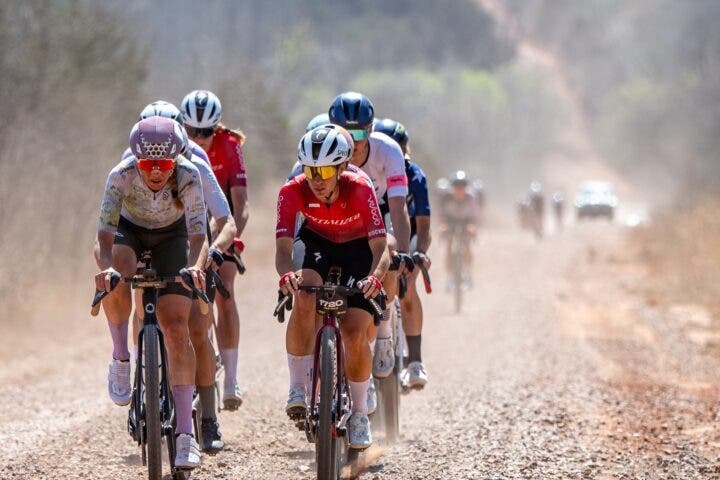
Unfortunately, the women’s race’s shine — with their own race and thrilling sprint finish in front of a large crowd of spectators — was dulled by some unfortunate negative story lines. Chief among them was safety concerns around lead vehicles and inconsistency around course marshaling at a few key road crossings.
The biggest hiccup was towards the end of the race as Sophia Gomez Villafane and Paige Onweller entered the final technical section with about 10 miles to go. In a video posted to Villafane’s Instagram, the side by side that was providing coverage of the women’s pro race appeared to veer towards Villafane and Onweller erratically as it seemed to lose track of where the course cut through a farm field.
In the post, Villafane criticized the organization for allowing a driver to be that close to athletes without the proper knowledge of the course to operate safely.
It is also worth noting that Villafane went on to win a thrilling nine-rider sprint at the finish 10 miles later, with the crowds still lining the whole final straightaway an hour after the men’s winners rolled through.
“One of the scarier moments of Mid South yesterday,” Villafane said in her Instagram post. “Not the first time I (or my fellow competitors) have just about collided with a media vehicle from their lack of course knowledge.
“At this point in time, it’s unacceptable that our safety keeps being compromised ‘for the shot.’”
That, mixed with the reoccurring criticism of gravel races using large vehicles on course that create large draft advantages, raised questions in the aftermath of the pro race.
Additionally, after the race a few of the pros from both the men and the women expressed concern over the lack of consistency around course marshals at key junction points along the way. Although the lead groups had the normal expected protection of corner marshals at intersections, anyone away from the front of the race didn’t have that protection.
“There were a few moments where there were people at corners, but they weren’t necessarily doing the best job,” Goettl said of the mixed bag of course protection.
“We were off the back, but I was still in the second group and we were racing. At times we had to be super cautious through intersections and we definitely could have lost time to the people in front.”
Now, this is not abnormal for a gravel race, most races still are run without road closures and it is up to the riders to have full awareness of this responsibility, but it was a notable change to how things worked on Saturday for the mass start event. There, almost every major intersection had course marshaling to keep the thousands of riders safe throughout the event.
Between the lead vehicles interfering with the racing and inconsistent course marshals, the pro race of Friday is far from a finished product. These were also the primary concerns that came with stretching the resources involved with race protection for two days. Nevertheless, moving forward, riders and fans will be without question expecting changes to happen.
Mid South posted a comprehensive apology on Sunday after the amateur event concluded late Saturday night. You can view that here.
Even with the hiccups, the format seems to be a winner
Yet, from a novelty standpoint and away from the concerns around safety, the split day was a massive change to the feeling of what a pro gravel race can be for riders and spectators alike, because of both the professional race and the enduring eclectic power of the Saturday event.
From a man smoking a pre-dawn cigarette while he got his beach cruiser ready for a 50-miler, to the full blown party at 11 p.m. for the last finisher — it’s all Mid South. But beyond the expo, the pro race, the drama that always seems to percolate from pro gravel racing, Saturday will also be the big show. All 16 hours of action will always be its beating heart.
And because of that, this year’s Mid South feels like a junction for gravel to build upon.